
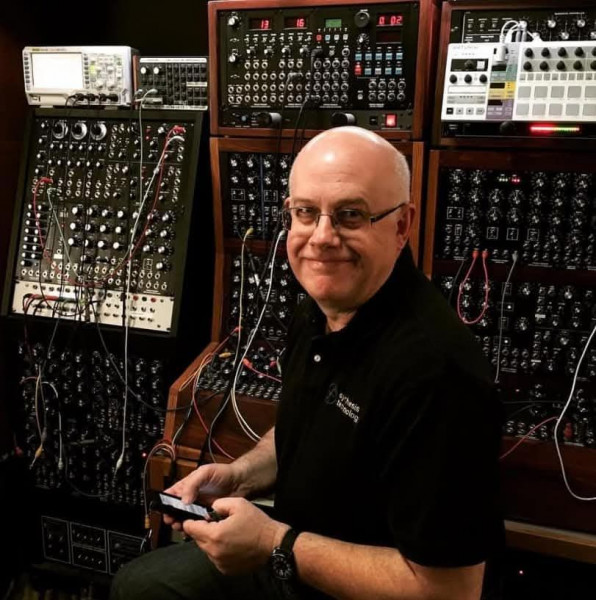
Paul Schreiber (1956-2025)
After a long and extensive career which touched countless lives and inspired countless musicians, Paul Schreiber passed away on March 23, 2025 at the age of 68.
The family has published an obituary with information about Paul's personal and professional life. Services were held in North Richland Hills, TX on April 1, 2025.
This website will remain online for as long as possible but please download any documentation you might need in the future.
Repairs and diagnostics for existing customers will continue to be provided through Field Services of Phoenix, AZ.
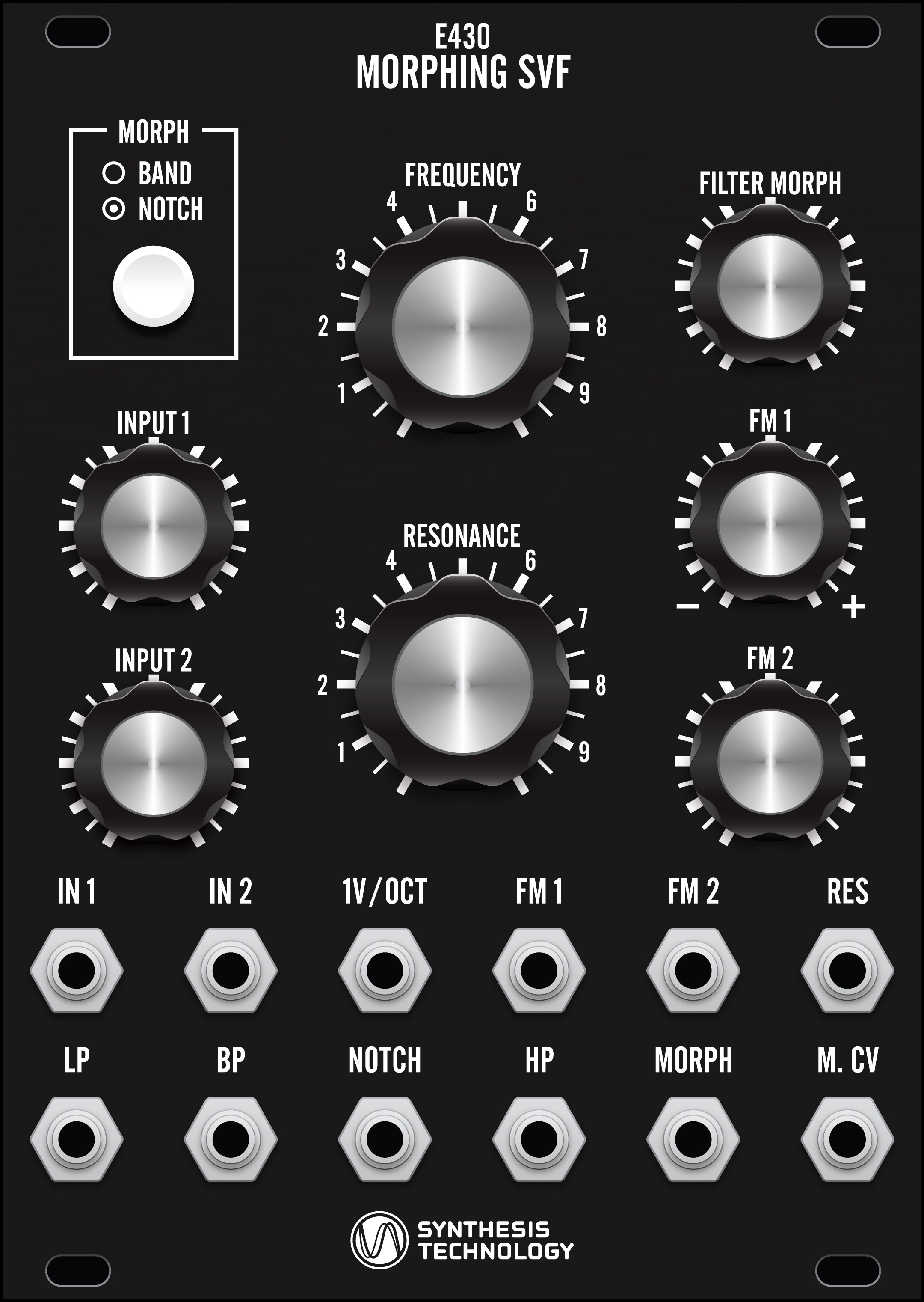
E430 MORPHING SVF
The E430 is a faithful re-creation of the classic Oberheim SEM 12dB/oct state-variable filter. Despite new features being added, the original SEM circuitry was not "improved" or updated. Great care was spent through measurements and beta testing to duplicate the SEM's unique sound.
The E430 is available through Analogue Haven. They are the exclusive dealer for this module.
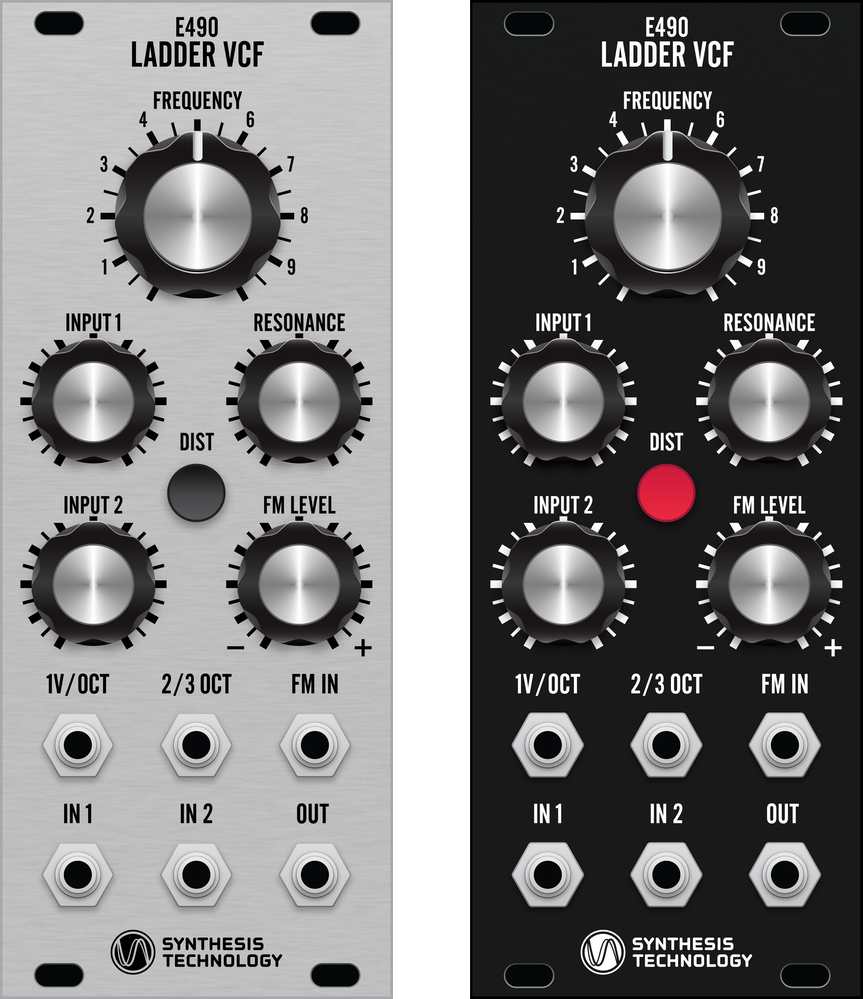
E490 Ladder VCF
The E490 is a faithful recreation of the Moog "Ladder" filter, with a switch that mimics the effect of patching the Minimoog output back into the audio input to add distortion.
The E490 is available through Analogue Haven. They are the exclusive dealer for this module.
Repair and Warranty Information
Synthesis Technology has authorized Field Services in Phoenix, AZ USA to be our repair service.
IMPORTANT: REPAIRS ARE NO LONGER COVERED UNDER A WARRANTY. PLEASE CONTACT FIELD SERVICES FOR ANY REPAIR NEEDS.
Field Servies is run by Matthew Averill, who at one time assembled modules for us when we were located in Arizona (2011-2015). His company repairs 100s of MI gear each year.
Here is an introduction:
"I started my audio electronics career at a music store in Massachusetts before moving to Phoenix, 24 years ago. I started to do repairs full time here at Field Services (founded 1989 by Jim Field) in 1999 and took ownership of the shop in 2018."
"We're authorized service for major brands (Harman Professional, Yamaha, Yamaha Guitar Group, Roland, Korg, Fender, and QSC, to name a few)."
"As far as modular synthesis goes, this is where the hobby/career are married. I've been working on the never-ending project that is my own modular since 2001."
"We're proud to be supporting Synthesis Technology users going forward into the future."
CONTACT MATTHEW VIA THEIR WEBSITE: fieldservicesaudio.com
Open Source Release - E951 Circuit Bent VCO Expander
We have released the source files (in C, targeted to a specific ST ARM chip), front panel drawings, schematics, and Gerber files.
This documentation is released under the following conditions
- NO TECHNICAL SUPPORT. This is NOT a DIY kit.
- The point of the exercise is to have people figure it out, and then SHARE your efforts.
- The original display used was some random OLED off eBay. Let's just say it is not what I would use today. HINT
There is NO REASON to 100% clone the mechanicals of this module. I used what was available at the time. Port it to Arduino? Sure! FPGA? FINE! Better display? PLEASE, I BEG YOU.
Get the files from Eric's GitHub: github.com/emeb/SynthTech-E951
E520 Hyperion V1.3 final production firmware released
Version 1.3 is the final production firmware release for the E520 Hyperion Stereo Effects Processor.
This version replaces prior V1.2 (production) and V1.3 RC (public beta) releases. No addional releases are planned.
There are new algorithms (yes, including reverbs), many new features and enhancements to the existing algorithms, and overall UI improvements. Details in the PDF files.
It is HIGHLY RECOMMENDED that you back up the E520 onto a uSD card before loading V1.3
The User Guide PDF is updated, and has the functions of every CV/button for every algorithm.
Get your copy here: synthtech.com/beta/E520_V13.zip
E352 V1.6b PRODUCTION CODE released
This is strictly a manufacturing parts update, that allows multiple SPI FLASH IC vendors (where your user patches are stored) to be used.
Note that new production E352s are shipped with V1.6b, which is only needed for modules build after Sept. 2021. If you have V1.6 already, there is NO NEED to get V1.6b
Get your E352 V1.6b (only if you have V1.5 or older, or need to reflash your existing version): synthtech.com/beta/E352_V16b.zip
E370 Quad VCO Firmware V1.6b Released
Version 1.6b of the E370 firmware adds many UI improvements, enhancements, and a new 4-note Chord Mode. Plus Moses, our QA Manager.
If you have Version 1.6 or V1.6a, please update to V1.6b as there is a bug fix for loading/saving patches.
Download the update here: synthtech.com/beta/E370_V16b.zip
Download WaveEdit, our free, open-source wavetable editor!
WaveEdit runs on Windows, Mac, and Linux. Using a simple interface and custom graphics, WaveEdit aloows easy editing, creating, and formatting wavetables for use in the E352 and E370 VCO. External wave samples can me imported (from Serum or other .WAV files) and scaled to fit into the E352/E370 format. Visit the WaveEdit page here for details.
NEW TUTORIAL VIDEOS
We've started a series of design videos, highlighting the CAD tools we use use here at SynthTech. You can subscribe to the SynthTech tutorials channel for the full series.
There are just a few now, in the months ahead we will add more and place them all on a single web page for quick browsing.
Please contact us if you have any feedback.