MOTM-730
VOLTAGED-CONTROLLED PULSE DIVIDER
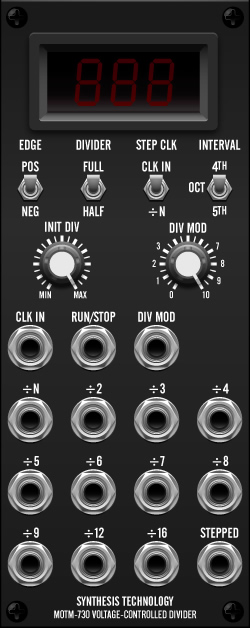
The MOTM-730 is a PIC microprocessor-based digital module that takes an input signal and generates lower frequency square waves at multiples of the input frequency. It is a "big brother" to the MOTM-120 Sub-Octave Multiplexer (when used in divide mode). Whereas the MOTM-120 divides by the multiples 2, 4, 8, and 16, the MOTM-730 can generate multiples from 1 to 33, as well as half-multiples (1.5 to 16.5). There is also an 8-step, positive-going sawtooth wave that has three user-selectable step intervals.
DIVISOR OUTPUTS
Each divisor output runs independent of the others. The only things they have in common are:
- All use the same input clock, and the same edge as set by the switch
- All outputs are 0V to +5V square waves (not AC coupled, but DC coupled)
- All respond to Run/Stop
Outputs are driven by 74HC244 line driver ICs with a 100ohm series resistance. The outputs are done in this manner to easily trigger/gate MOTM-800 envelope generators and control MOTM-190 VCAs. You can also treat the outputs as audio, but before sending these signals to a mixer/amplifier, you need to pass them through an AC coupled module first, such as a VCF or the upper channel of a MOTM-190.
The /N output follows the setting shown in the LED display, as set by the addition of the front panel setting and any applied control voltage.
Remember, the silkscreen on the panel is for the FULL setting! Switching to HALF means the outputs speed up by 2X (because the ratio is 1/2 of the printed setting).
STEPPED OUTPUT
This output is a positive-going (starting at 0 volts and incrementing upward), 8-step, sawtooth waveform. There is 1 step at 0V, and 7 successive steps of positive voltages. The amount of each step is set by the panel switch (as 'heard' by applying this output to a VCO). The voltage is fairly accurate, but not really accurate. If you want to 'tune in' a more precise interval, use the OCT (octave) range (1V/step) and apply this to the FM IN of a VCO. Then, you can 'dial in' what the interval is. This was just a fun, cheap added output. Use it to drive VCOs, VCFs or audio, too (has a nice raspy tone).
This module requires a MOTM-950 or another power supply with a 6-pin MTA-156 power connection (+/-15V @16ma, +5V @100ma).