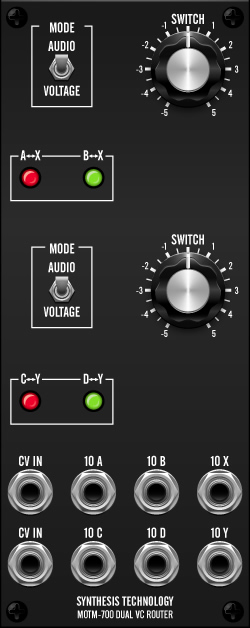
MOTM-700
DUAL 2:1 VOLTAGE-CONTROLLED ROUTER
The MOTM-700 is another Synthesis Technology exclusive module! It is a bi-directional, dual SPDT (single-pole, double-throw) switch that is "toggled" when an input control voltage exceeds a trip-point set by a panel knob. Special circuitry handles routing of audio (cross-fading VCAs) or control voltages (fast, low-offset switches).
The MOTM-700 has two identical sections, so we will discuss how each of them operates. The two are totally independent from each other, and can be connected in series or in parallel, to each other or to additional MOTM-700 modules.
Think of a SPDT mechanical switch. When the switch is up, Signal A is connected to the "common" terminal (let's call it X). So we say, "A is routed to X." If the switch is down, then Signal B is connected to X. There are two ways of viewing the connections: two inputs are routed to one output, or one input is routed to two outputs. The switch doesn't care: it's truly bi-directional.
This is exactly how the MOTM-700 works. What makes it useful in any studio is that you control the selection with a control voltage! The MOTM-700 uses a circuit called a comparator that "compares" the input control voltage with another voltage, set by the Switch knob and adjustable from -5V to +5V.
Operation is easy to remember:
- If the CV IN voltage is less than the Switch value, then A and X are connected.
- If the CV IN voltage is greater than the Switch value, then B and X are connected.
So what is it good for? The fun part is choosing the source of the CV input. Here are just a few examples:
- Use a voltage-out footpedal. Pedal up, A routes to X. Pedal down, B routes to X.
- Use an LFO waveform. A triangle will cause the A and B signals to "ping-pong" to X. The Switch value determines the duty-cycle of the routing!
- Use the S&H output from a MOTM-101. The Switch value becomes a voltage-controlled probability function! The higher you set the voltage, the greater the chance A routes to X.
- Use the output from your keyboard controller. Instant voltage-controlled split point control!
The Mode switch selects if audio or control voltages are being routed. In the Audio position, a special IC actually switches by a very fast cross-fading between channels. This eliminates "pops" and "clicks." The IC is rated for CD-quality switching: better than 90dB SNR with less than 0.002% THD. Shielded RG-174 cables are used for all audio signals.
If the Mode switch is set to Voltage, a high-speed low-resistance CMOS switch is used (NOT one of the cheesy '4066' types). This IC is good enough for switching VCO control voltages without adding drift or offsets. It can also switch at audio rates as well! This can result in some very bizarre timbres (check out the audio demos).
We think that the MOTM-700, once understood, will find hundreds of uses in your studio—not just as another module in the MOTM family, but as a standalone accessory for routing just about any signal in your setup.