MOTM-101
Noise Generator / Sample & Hold
The MOTM-101 is an essential part of any synthesizer system. It is a dual-function module, where the Noise Generator is linked to the Sample & Hold section without the use of patchcords. Each section can operate independent of the other.
Noise Generator
The Noise Generator uses two Zener diodes to create white noise. This white noise contains spectral harmonics from near DC to well above hearing. This type of noise is useful for simulating cymbals, ocean waves, static, and other types of "nature" sounds. It is also useful in generating random signals into the sample & hold, and for aperiodic, high-speed clocking.
The white noise is low-pass filtered at approximately 2500Hz to create pink noise. Pink noise is useful for lower frequency sounds such as thunder. The pink noise is filtered even more to generate random output, which can randomly modulate filters and VCOs.
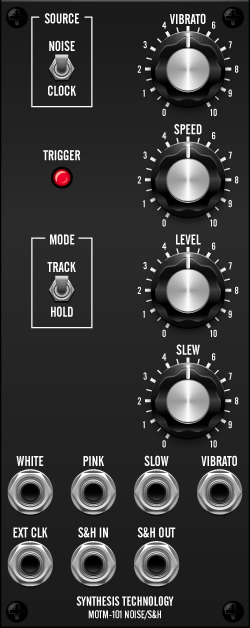
These three types of noise are found on many synthesizers. However, look closely and you will see the jack labeled Vibrato, and its associated control knob! This is a MOTM exclusive: a high-Q bandpass filter (the panel control controls the Q) that generates sine waves centered around 7Hz of random amplitudes (and slightly varying frequencies as well). On the panel, a switch selects driving the bandpass filter with either white noise or the internal/external clock from the sample & hold section. When the panel switch selects white noise, the vibrato output is a 'wandering' sine wave, perfect for adding realistic vibrato and tremelo. If the switch is in the clock position, each time the clock cycles the output filter rings in a dampened sine wave (the ringing amount set by the panel control).
Sample & Hold
A Sample & Hold circuit is a sort of voltage memory: each time the clock generator cycles, the signal on the Input jack is captured and stored on a special capacitor. This voltage is buffered and fed to the Output jack. Even with many seconds between samples, the output voltage remains nearly constant (since no circuit is perfect, the output voltage will droop, but at a miniscule rate on the order of 1mv per second). The MOTM-101 contains an internal clock oscillator, whose speed is set by the panel control. A red LED flashes at the clock rate. Plugging another clock source (VCO, LFO, etc) into the External Clock input overrides the internal oscillator.
Again, sample & hold is a part of many synthesizers... but wait! Hmmmm... what's that switch marked Track/Hold? Another MOTM exclusive! In the HOLD position, the circuit acts like a "normal" sample & hold: the output is held steady at the start of each clock cycle. But, in the TRACK position, the output follows (tracks) the input when the clock is low (less than 1.5 volts) and holds the output when the clock is above 1.5 volts. If you are familar with TTL digital logic, this mode is referred to as a "transparent latch." From a musical standpoint, this can generate more unique sounds than other sample & hold modules.
The Slew control adds portamento or glide to the sample & hold output. It can be adjusted from zero to ten seconds.